
Booking an electronic music festival starts long before anyone asks which DJ is free. We first decide what that slot needs to do: shift tickets, set the tone of the event, carry peak time or give a new concept some credibility. Each job points to a different set of names.
The same artist can quote very different terms depending on the date, territory, format, billing and route. A DJ set is not booked in the same way as a live set, hybrid performance or audiovisual show either. Before approaching artists, we weigh the musical direction against capacity, sales history, production and budget. We use that as the starting point for our artist booking and event services.
A big market, but a hard one to budget
Spain's live music sector generated €807.2 million in ticket revenue in 2025, up 11.24% on the previous year, according to the Spanish Association of Music Promoters' 2026 Live Music Yearbook. Madrid and the province of Barcelona accounted for 46.34% of that revenue.
That figure measures activity, not margin. It covers every genre and says nothing about what individual artists were paid. In APM's certified ranking, Sónar reported an aggregate attendance of 161,000 and 117 performances across three days. It was one of Spain's five best-attended paid multi-artist festivals in 2025. APM counts attendance across the event, so the total does not necessarily represent 161,000 different people.
The Spanish Ministry of Culture's Survey of Cultural Habits and Practices 2024–2025 helps show the scale of festival attendance. In the previous year, 32.1% of people aged 15 and over attended a contemporary music concert. Of that group, 35.3% went to a festival or large-scale festival. The survey does not break attendance down by genre, but it does confirm the importance of the festival format in Spain.
In electronic music, national borders explain only part of the market. Spanish dates compete within European routings and international calendars. The IMS Electronic Music Business Report 2025/26, produced by MIDiA Research, valued the global electronic music business at $15.1 billion in 2025. That estimate includes recorded music, publishing, platforms, clubs, festivals, technology and brand deals. It is not an index of artist fees. The report also put Ibiza club ticket revenue at €160 million, €10 million more than in 2024, despite fewer events per venue.
Strong national revenue does not make every date profitable. In the 2025 Valencian Music Yearbook, PROMFEST president Joanvi Díez links price pressure to competition between festivals, territorial exclusivity and the arrival of operators with greater financial capacity. His assessment is specific to the Valencian sector, not a Spanish average. Promoters who have chased the same route as neighbouring festivals will recognise the problem, though.
None of the sources provides a complete fee series by artist, genre and territory. That is why we avoid claiming that "DJ fees" as a whole have risen at one common rate.
What pushes a booking price up or down
The calendar matters. On busy festival weekends, several buyers may be chasing the same artists. If a date sits naturally within a tour through the Iberian Peninsula, travel can be simpler. If it requires a separate fly-in and fly-out for one show, flights, hotel nights and downtime start to accumulate. That can improve or worsen the total cost, but a convenient route never guarantees a lower fee on its own.
Territory comes next. We look at the artist's last appearance in the market, what else is announced nearby and whether another date could dilute sales. Exclusivity should address that specific risk. Asking for an excessive radius by default may stall the negotiation or raise the price without giving the festival meaningful protection.
Format and set time matter too. A closing set, peak-time slot and appearance on a secondary stage do not carry the same value. Nor do a DJ set, B2B and live show with touring equipment place the same demands on production. Artist momentum also changes the picture. A release, residency, agency move or breakthrough in another territory can alter demand within months.
APM covers this pressure in its feature "El precio del aplauso" ("The Price of Applause"), based on interviews with Spanish promoters and agents. They discuss competition for artists, more expensive riders, hotels, hospitality and production. These are professional accounts rather than national statistics. They show where operators are feeling pressure, but they do not justify adding the same percentage to every artist on a bill.
How we balance the line-up
A headliner may be expected to sell tickets, reassure a sponsor, attract press coverage or put a new event on the map. Assuming one name will deliver all of that at once is usually the first mistake.
Follower counts and monthly listeners are useful signals, but they reveal little about conversion in a particular market. We cross-check them against previous ticket sales, ticket price, recent appearances in the area and fit with the concept. A globally bigger artist may already be overexposed locally. Another with a smaller worldwide audience may have a far more active following in that city.
Before making an offer, we work backwards from the numbers: how many tickets the artist would need to contribute, the communications spend, final ticket price and the effect on the rest of the bill. We also run the uncomfortable scenario in which sales arrive late or fall short. That calculation does not dictate the musical direction. It shows how much of the event is resting on one booking.
A line-up needs a clear hierarchy and flow. The headliner opens the sale, the next tier gives the programme substance, and specialist artists give it a character of its own. Residents provide continuity and connect the event to its local scene. Set times matter: the right booking in the wrong slot can throw the whole night out of shape.
We also ask whether the format adds anything. A B2B put together merely for novelty often works less well than two properly placed sets. A live show can become the festival's point of difference if the running order allows enough room for changeover, soundcheck and the space it actually requires.
Residents work when they receive thoughtful programming, the right slot and professional conditions. Treating them only as a way to close a budget weakens the line-up. The reverse is also true. If one headliner absorbs the money needed for sound, staging or the next tier, the name gets bigger on the poster while the festival itself becomes less convincing.
From artist fee to the real cost of the date
To compare two proposals properly, we first cost getting the artist to site and delivering the show. That includes:
- the artist fee, agency commission where applicable, and tax;
- flights or trains, luggage, rooms, ground transport, per diems and hospitality;
- DJ equipment, instruments, backline and any additional technical hire;
- touring personnel, security, runners and the local artist liaison;
- insurance, bank charges and currency risk;
- recording, streaming, image and brand usage rights;
- exclusivity, cancellation, force majeure and promotional terms.
The tax position needs to be settled before drafting a net or gross offer. Spain's Tax Agency explains that a performance in Spain by a non-resident artist may generate income subject to non-resident income tax (IRNR), even when another person or company issues the invoice. We review tax residence, the contract and the relevant treaty for every deal. Copying a percentage from an earlier booking is poor practice.
The lowest fee does not always produce the cheapest booking. A cheap-looking offer can become expensive once you add an isolated journey, a large touring party or equipment outside the festival's inventory. You find that out during negotiation and the advance, not on build day.
A Spanish date often sits within a wider route. Travel and hotel requirements may become simpler if the event fits between two other shows. They change if the artist has to make a separate journey. Where the project allows it, we work with date windows, although the artist's schedule, billing and territorial strategy may carry more weight than the mileage.
The hold position is another basic piece of information. A hold gives provisional priority over a date; a written offer may already create obligations. Before sending one, we agree the spending ceiling, who can approve it and when the decision expires. If the internal sign-off needs a week and the agent wants an answer within 24 hours, pretending there is room only postpones the problem.
Announcing the artist or buying travel before the contract is signed adds risk without adding value. It sounds obvious, but it still happens.
In electronic music, the booth is part of the deal
A poorly advanced booth can undo a deal that looked solid on paper. For a DJ set, we confirm the model and number of players, mixer, equipment condition and firmware, connections, network, monitoring and table stability. We also plan changeovers, backup lines and who will respond if a unit fails.
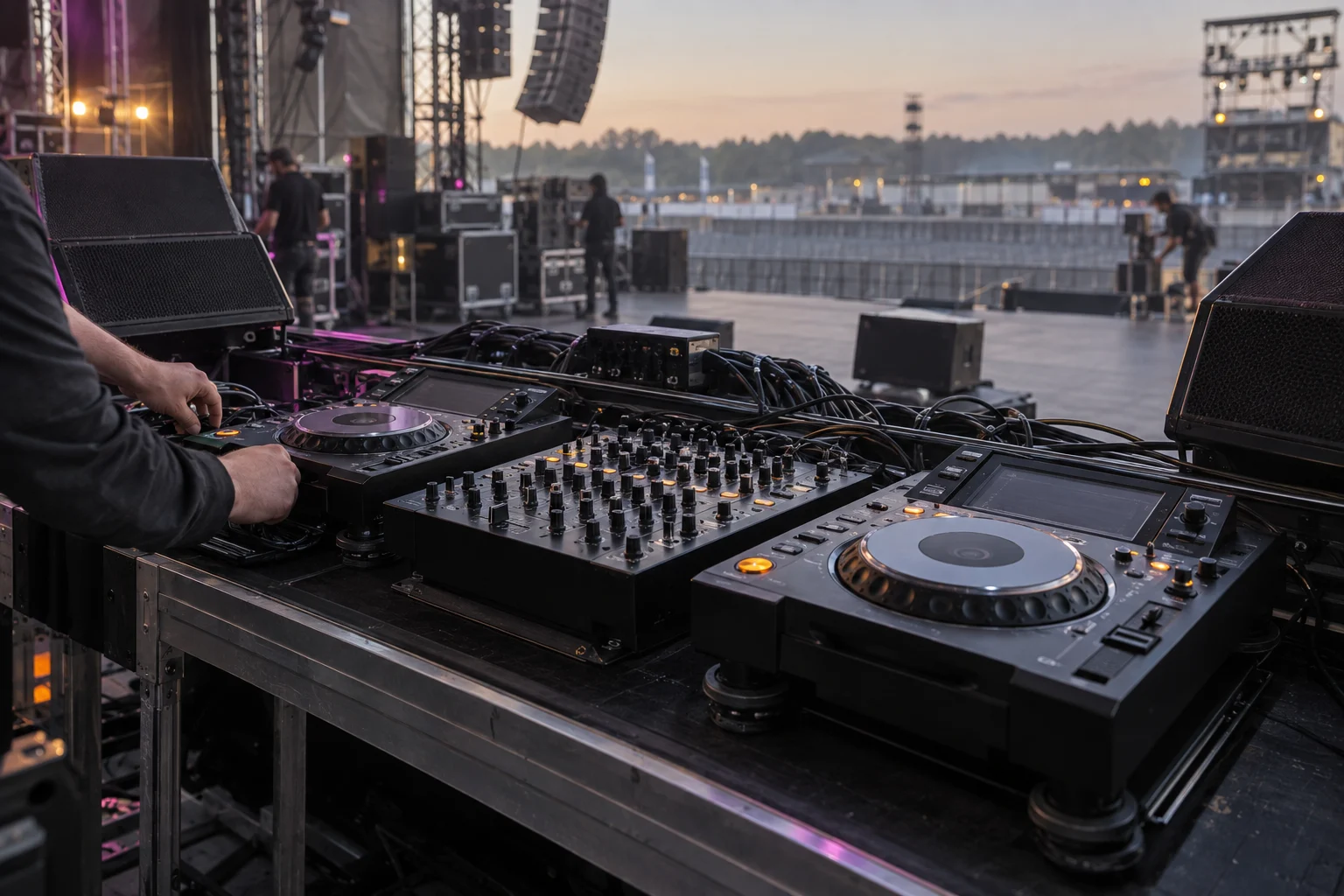
A live or hybrid show needs a different conversation. It may involve computers, interfaces, synthesisers, drum machines, controllers, microphones, stems, sync, timecode and video. The patch, tests and changeover must fit the running order we will actually deliver.
Recording or broadcasting the set requires permission. The same applies if a sponsor wants to use clips, if the show includes branded visuals or if someone requests special backstage access. These rights belong in the agreement. They should not be improvised with a camera already rolling during the show.
Hospitality is part of the job as well: rooms, dietary requirements, dressing rooms, transfers, accreditation, security and departure times. A transfer with no margin or a poorly planned check-out can disrupt the next day's route. A good movement sheet prevents many of those problems.
When the numbers do not work
Sometimes the budget simply says no. We then return to the job the artist was meant to do. It may make sense to move the date, shift some of the headliner budget into the next tier, back an artist with stronger local traction or reduce the number of stages. We also revisit capacity, ticket price and production before looking for another name.
An emerging artist can work if the momentum is real and the event's audience recognises it. A resident may take a more prominent role when they are part of the project's identity. A format change can help when the artist offers it and it makes the date better. Asking for a stripped-down version solely to hit a number rarely solves the underlying issue.
A long email of available names may fill a page, but it does little for the programming. If the alternative fits the budget but not the event, we keep looking.
A high fee may be entirely rational in the artist's market and still be unworkable for our event. We walk away if it requires sales we cannot substantiate, pushes the ticket price beyond the market or consumes money needed to produce the show properly.
We also stop if the exclusivity blocks too much territory, if the musical fit distorts the concept, or if the remaining time for contracts, permits, travel and production is no longer realistic. Cash flow matters. Committing to a guarantee is of little use if there is not enough left to deliver the rest of the festival.
If the guarantee compromises production or depends on a single optimistic forecast, we stop before sending the offer. Walking away early is usually much cheaper than carrying that forecast all the way to show day.
What we need before we start
A useful first brief should include:
Event concept, subgenres and references:
City, venue and sellable capacity:
Date and possible alternatives:
Timings, curfew and the artist's role:
DJ set, live, hybrid, audiovisual or another format:
Ticket price and access model:
Target audience and comparable sales history:
The rest of the confirmed or planned line-up:
Requested territory and exclusivity:
Artist spend range and total event budget:
Available production and technical constraints:
Required content, streaming or image rights:
Who approves, who signs and when the decision is due:
With that information, we can assess availability, routing, total cost and fit. Without it, any artist selection remains provisional.
Before the first offer goes out
The decisions that hold a line-up together are rarely glamorous. They include rejecting an excessive exclusivity request, catching a production cost early, placing a resident in the right slot and withholding an offer that only works at a sell-out. Those decisions often determine whether the event works.
From our base in Andorra, La Borda Creativa works on booking and production projects and collaborates within Spain's electronic music scene. In 2026, we joined the Papagayo Tenerife booking team. If you are planning a festival, concert series or club show, send us the date, venue, capacity, investment range and two or three musical references. We can then assess availability, routing and the all-in cost to the event.
Sources
- Asociación de Promotores Musicales (Spanish Association of Music Promoters), 2026 Live Music Yearbook: the Spanish market, certified festival rankings and professional accounts of cost, production and risk.
- Federación Valenciana de la Industria Musical and PROMFEST, 2025 Valencian Music Yearbook: Valencian promoters' assessment of fees, exclusivity, costs and sales.
- International Music Summit and MIDiA Research, Electronic Music Business Report 2025/26: the international electronic music business and Ibiza's club market.
- Spanish Ministry of Culture, Survey of Cultural Habits and Practices 2024–2025: attendance at contemporary music concerts and festivals in Spain.
- Spanish Tax Agency, taxation of non-resident performers without a permanent establishment.